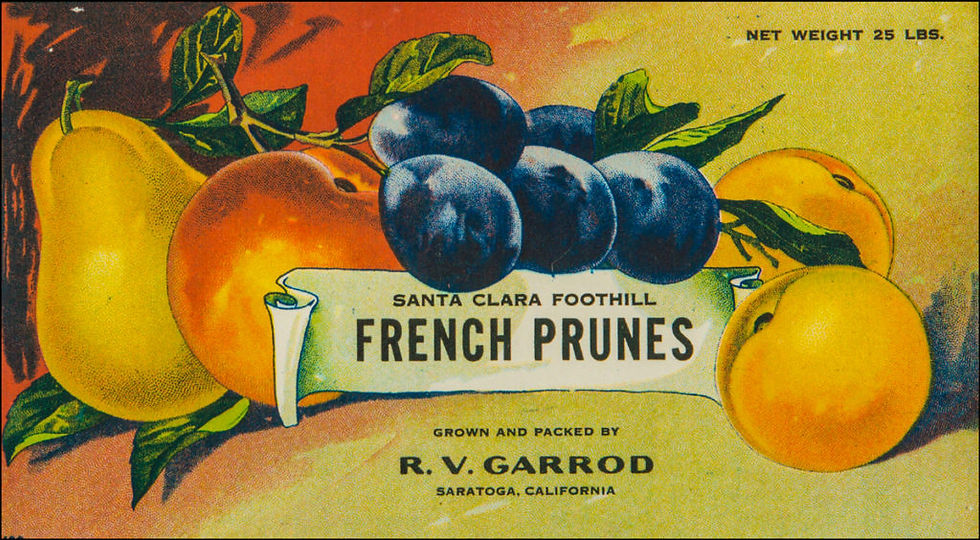
Upon lands that native Ohlone peoples had lived for thousands of years, Europeans arrived. The Spanish explorer Juan Bautista de Anza camped in what is now Cupertino, California in 1776. Over next decades Spanish settlers trekked between San Francisco and Monterey along what would become the El Camino Real. Travelling with them were European cultivars of grape vines and fruit trees. Since Santa Clara Valley has the same climate as southern Spain, those crops transplanted quite easily from Europe. Grapes were brought by the first Catholic missionaries so that sacramental wine, a required component in religious practices of the colonizing Spanish, could be grown. Apricots perform particularly well here with a major crop mentioned in the records at Mission Santa Clara in 1792. By the 1840s, this part of Alta California boasted a population of over 1000.

The discovery of gold in California would forever change the social fabric of the region by bringing in massive numbers of settlers from other parts of Europe. By the early 1850s, French vintners would establish the valley as a premium wine-producing hub with wine labels such as Le Franc and Mirassou. Orchardists such as Louis Pellier, considered the "Father of the California prune," propagated the French Plum, adding another commercial crop. The region continued to grow. The 1860 census records a population over 12,000 in Santa Clara Valley.

By 1900 Santa Clara County had over 7,000 small family farms that ranged from ten to fifty acres in size. Vast swathes of the flat alluvial plains of Santa Clara Valley were transformed into large family orchards dedicated to the monoculture production of flowering stone fruit such as apricots, peaches, plums and cherries. Nut trees such as almonds and walnuts were also popular. Farmers from other Mediterranean regions, such as Croatia, Portugal and Italy arrived and labored in the fields and canning plants.

By the 1920s places like Saratoga, Cupertino, Sunnyvale and Campbell became renowned for fruit with more than 8 million fruit trees blossoming each spring. In the 1920s and 1930s it was common for Japanese tourists to visit and enjoy the fragrant sights of blossoming trees in Spring. And as late as the 1950s, bus tours of the blossoms were still popular.
Why Karpophoros?





Thus Karpophoros represents the agricultural fecundity of this area and we honor and worship the gods & goddesses that help bring about that fertility to Northern California. That quintessential spiritual energy has been immortalized in the famous poem,
"The Valley of Heart's Delight."


Karpophoros is also an epithet for the goddess Demeter
9 New Inscriptions from Ancient Phrygian City of Akmoneia Include First Evidence of Demeter Karpophoros in Phrygia
Newly published inscriptions from the ancient Phrygian city of Akmoneia in western Türkiye reveal separate but connected glimpses of Roman-period urban life: a torch-bearing statue dedicated by a local benefactor, a statue-lined main street, the first epigraphic evidence for Demeter Karpophoros in Phrygia, and a funerary poem for a man who appears to have died violently far from home. The inscriptions were discovered during archaeological surveys in the territory of Akmoneia, located at modern Ahatköy, about 10 kilometers from Banaz in Uşak Province. The study by Hüseyin Uzunoğlu of Akdeniz University and Münteha Dinç of Uşak University has been published in the journal Gephyra. The inscription located on Akmoneia’s main street records that Hierokles, son of Menandros, together with his son Hermogenes, erected a statue of Demeter Karpophoros, “Demeter the Fruit-Bearer,” and dedicated it to the divi Augusti and the people.

On the Athenian Acropolis, by the seventh column of the northern colonnade of the Parthenon, just a few meters from the temple, a brief inscription is cut into the living rock. It reads:
Γῆς Καρ | ποφόρου | κατὰ μα{ι}ν | τείαν
The inscription, which is datable to the 2nd century CE, designates a small area as sacred to Ge Karpophoros, i.e. to the fruit-bearing Earth, in accordance with an oracle. The succinct wording does not provide us with more details—no further information about who received the oracle, or on what occasion the oracle was sought. Today, the inscription is easily overlooked, but during antiquity the sacred space would have been clearly indicated and situated in an area of high visibility which most visitors would have passed. Certainly, the inscription was noticed by one of the most famous visitors to the Acropolis—Pausanias. While visiting the Sacred Rock, Pausanias saw a statue of Ge “beseeching Zeus to rain upon her”, and the inscription has naturally been associated with this statue. Moreover, this account provides us with a possible context for the oracle: Pausanias’ interpretation concerning the erection of the statue was that “perhaps the Athenians themselves needed showers, or maybe all the Greeks had been plagued with a drought”.
-
1. J. Wallensten, "Karpophoroi deities and the Attic cult of Ge. Notes on IG II2 4758", Opuscula 7 (2014) 193
Demeter was not the only deity to be honored with the epithet "Karpophoros"
Professor Wallensten from the Swedish Institutes at Athens has written one of the best treatments of Karpophoroi deities and the Attic cult of Ge in her article on Greek inscriptions. (1)
The Demeter inscription is especially important because the authors identify it as the first epigraphic evidence for Demeter Karpophoros in Phrygia. The cult of Demeter Karpophoros is known elsewhere in Asia Minor, including major centers such as Ephesus, Pergamon, and Sardis, but this text appears to bring that title into the Phrygian epigraphic record for the first time.
Demeter’s title Karpophoros linked her to fertility, crops, and agricultural abundance. In a region where rural production and local landholding mattered deeply, such a goddess would have carried both religious and civic weight. The fact that her statue stood on the main street shows that agricultural prosperity was not hidden in the countryside; it was displayed in the city’s public language of honor, piety, and status.
Hierokles himself was not simply a donor. The inscription says he had served as priest and as agonothetes, or organizer, of the Great Asklepieia, a festival connected with Asklepios, the god of healing. That detail places him among the civic figures who paid for religious and public life, turning private wealth into visible prestige.
Uzunoğlu, H., & Dinç, M. (2026). New Inscriptions from Akmoneia. Gephyra, 31, 103-123. https://doi.org/10.37095/gephyra.1942630
